Why Effective AI Agents Are Often Less Complicated Than They Look
From routing and parallelization to evaluation loops: clear task design matters more than maximum autonomy.
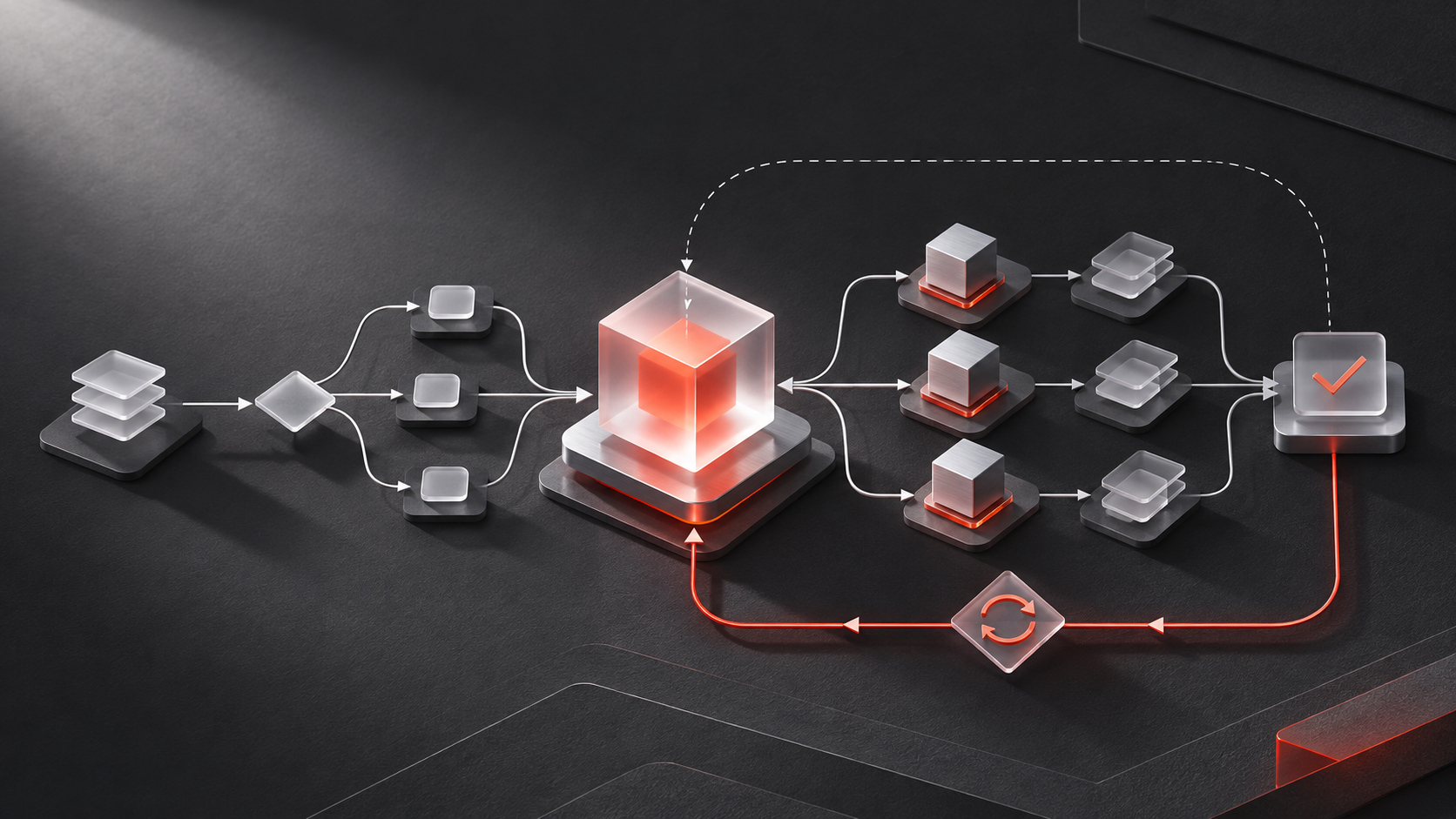
As ‘agents’ become a standard feature in AI products, one question is frequently skipped: does the task actually require an autonomous agent? Many dependable systems begin not with a more elaborate framework, but with a more explicit task boundary.
Start by separating workflows from agents
Anthropic offers a practical distinction between two kinds of systems. A workflow coordinates models and tools through predefined code paths. An agent allows the model to direct its own process and tool use dynamically. The first is more predictable; the second is more flexible, but can introduce greater latency, cost, and compounding error.
This distinction matters in product design. Customer-service routing, fixed-format generation, and document review can often be decomposed into known steps. Open-ended research or coding across many files is more likely to require dynamic planning.
Five patterns that are often more useful than full autonomy
Prompt chaining divides a complex task into sequential steps. Routing sends different inputs to specialized processes. Parallelization handles independent subtasks at the same time. An orchestrator-worker pattern lets a central model break work down dynamically. An evaluator-optimizer pattern improves results through structured feedback.
All five patterns make responsibility explicit. They do not assume the model will get everything right in one attempt; instead, they use checkpoints, division of labor, and feedback from the environment to improve reliability.
The engineering question is not whether an agent can be added. It is whether the added complexity produces a measurable improvement.
Begin with the simplest viable system
If one model call, retrieval, and a few examples are enough, there is little reason to introduce a long autonomous chain. When an agent is justified, it still needs stopping conditions, sandboxing, human checkpoints, and well-documented tools. The more autonomous a system becomes, the more it must rely on ground truth from its environment rather than its own confidence.
Three tests for product teams
- Can the task be decomposed in advance? If so, prefer a workflow.
- Can the result be verified? Automated tests, explicit rules, and human review materially reduce risk.
- Is flexibility worth the cost? Let the model plan dynamically only when a fixed path cannot cover the problem.
Source: Anthropic, “Building Effective AI Agents”. This article is an independent editorial synthesis, not a reproduction of the source.